Logopond: Collection of logos for your inspiration
We speak from heaven
On June 26, 2004 the then European Commission Vice President Loyola de Palacio, Colin Powell signed an agreement on the EU and the U.S. shared their global positioning system satellite to be used jointly and complementary. The American system is known GPS. The European Galileo called.
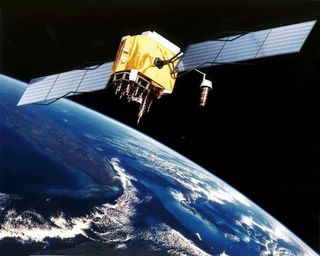
GPS (Global Positioning System) was developed as such between 1974 and 1979 by the Department of Defense United States. In principle served only for military purposes, and its design clearly oriented technologies included in this regard. For example, GPS satellites launched since 1980 incorporated sensors that detect NUDET called nuclear explosions and to assess damage in the affected area. We must take into account the time running by then. But the main quality of the GPS was and is easier to find land for anything, anywhere, to within a few meters. Today we can buy a gadget GPS anywhere. By now virtually all means of transport, public or load bearing one. We go on the road to that magic box and a screen showing you what is ahead, and even tells you turn at the next exit and stuff. So glad to go. But how does this work? We have the GPS device on earth and orbiting satellites. How can the 25 GPS satellites communicate with thousands of gadgets on the ground at once, and tell each particular position? What happens is this: All the satellites have a high-precision clock. They also have a system of issuing high-frequency pulse and low intensity. To be synchronized, all these drives emit exactly the same time. A ground-based GPS device is receiving the pulses of the different satellites, and as further from each other satellites, some pulses will arrive a little later than others. The farther away the satellite, the higher the short delay. Using the values \u200b\u200bof the delays between signal and signal, the device itself can calculate the exact position anywhere on the planet. So each satellite is limited to announcing its particular position, you orbiting while saying "I'm here" and a little later "I'm here," as it moves in its orbit. If the GPS device on earth receives the signal, at least 3 of the 25 satellites will have the location you want. Why 3? The reason is purely geometrical: Each satellite broadcasts its signal in all directions, then the sign is like a sphere that grows from each satellite. We can say that all areas are growing and at some point collide with the GPS device which is located at a point in space. Then it is a simple problem of intersection of fields, from those who did in high school: The intersection of two spheres is a circle. If this circle intersects with a third sphere, we get 2 points. And if these two points intersects with the fourth area, we get the point we wanted. But wait, we said 3 satellites, then 3 fields. What is the fourth area that we used? As in our case it is the planet Earth. In summary, we define any point on Earth's surface to the intersection of three radio signals at that point. If you only needed 3, why we have 25 GPS satellites in orbit? First, to go over. And then to cover as many places as possible. In these 25 will be joined by all 27 of Galileo, the EU will put in orbit later this year. Both joint and cooperative will provide coverage to 98% of positioning devices. May be turned off if it senses that are used for terrorist purposes, but otherwise will be a global public service. A great deal for an excellent system.
Wednesday, March 30, 2011
Phoenix Superior Court
Related Sites:

- Technology News
Related Videos:
Here are a collection of videos related and not so related to this article.
Title:
Manuel Amaya-talk

Manuel Amaya and her flamenco Combo in
Vendrell
Title:
South Africa 2010, Speech Messi and Carlos Tevez from concentration

Carlos Tevez and Lionel Messi speaking after today's practice in South Africa, statements

Subscribe to:
Post Comments (Atom)
0 comments:
Post a Comment